 The first time I ever stopped to look at a Playboy Magazine was my sophomore year in college. I’m sure I had flipped through a couple before that time, but never with any interest and usually with a mild disgust. But once I became aware that Playboy was one of the first magazines to publish interviews and stories by the likes of Vladimir Nabokov and Kurt Vonnegut respectively, I began to seek out old issues to satisfy my literary cravings. To say that I now read the magazine exclusively “for the articles” was both ironic and completely true.
But that’s not to say that I didn’t look at other magazines exclusively for their pornographic pictures; I did. It just happens that Playboy contrives its images to appeal to those readers who have sexual desire for women. And as such it only publishes pictures of women. And, needless to say, I wasn’t interested in them. When I was sneaking into other people’s hidden stashes of porn, I usually looked for the titles like Hustler magazine that included sexually aroused men in their photo spreads. Sure these men were focusing their attention on the women in the picture, but that did not stop me from focusing upon them. And luckily, my older cousin and my grandfather, both of whom had large stashes of magazines that I was lucky enough to discover, had plenty of copies of Hustler along with its more “prestigious” counterparts.
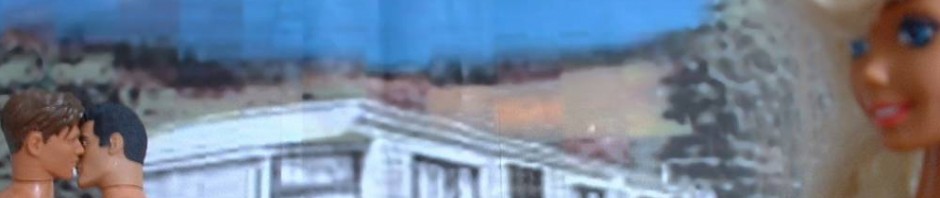
But this isn’t really about porn, well, not entirely and not yet. So let’s turn our attention away from the above attention-getting picture and anecdote and think about art, it’s value, and our subterfuge.
First up is the new Ang Lee movie, Brokeback Mountain. I heard about this film 6 months ago, and it is still 3 months from being released, and yet I see film stills, outtakes, and discussions of the movie almost daily on many blogs that I read. (yes, occasionally it is okay to read something other than Tony. BUT ONLY OCCASIONALLY!!!!) What is the all the hype about? Well, more than likely it has something to do with the fact that the movie features a gay relationship between cowboys, and that these cowboys are played by Heath Ledger and Jake Gyllenhaal. AND, in my opinion, the fact that many people are anxious to see those two actors kissing, hugging, and doing many more things naked together. Some people are willing to admit this freely, like Trent from Pink is the New Blogwho had the opportunity to attend a private screening of the film. He said that “The love scenes are brutally honest … and believe me … they are hot as well.”
And then there’s Andy from Towleroad. He describes, beautifully, the artful and powerful way that Ang Lee tells the story in an honest way in order to make an important social point: “That is the crux of this movie, an epic, slow-moving, genius film that is not so much a film about the taboo nature of gay sex as it is about the pain that will no doubt prevail when one is forced to hide one’s true sexual proclivities behind a veil of secrecy.”
However, he then underscores this point by spending several paragraphs describing, what else, the sex:
“And then there’s the sex. For the first time, two young A-list actors rising in their careers have taken on roles that require them to not only sell an audience their affection toward one another, but also their overt sexual undertakings.
Consider me sold.
The two actors make out hungrily, wrestle around, intimately embrace naked by the golden light of a campfire, and if you’ve read the Proulx short story you’ll remember this bit:
‘Ennis ran full-throttle on all roads whether fence mending or money spending, and he wanted none of it when Jack seized his left hand and brought it to his erect cock. Ennis jerked his hand away as though he’d touched fire, got to his knees, unbuckled his belt, shoved his pants down, hauled Jack onto all fours and, with the help of the clear slick and a little spit, entered him, nothing he’d done before but no instruction manual needed.’
Those who come to Brokeback expecting Falcon video’s Buckleroos will no doubt be sorely disappointed. But Ang Lee’s visual shorthand does Proulx’s erotic storytelling justice. There was more than enough sex for me in the context of this story, because the emotional tension makes the small moments count for so much. Those intent on seeing full nudity will see it in a less charged context as well  Twist changing by a lake, del Mar skinnydipping in a river.”
I’m freely willing to admit that I look forward to these scenes as well. And I think that is the point. Even a potentially important film which makes a statement in support of people who must face discrimination is overshadowed by its titillation quotient. Which has lead me to wonder how often our tastes are actually driven by our desire. I think my youthful attraction to sex is still (obviously) alive and kicking. But whereas I used to feel comfortable in indulging my desires by sneaking peeks at hidden magazines, now I find more socially approved of venues to achieve the same satisfaction. If the sex comes with some literary or artistic merit then I am free to enjoy it. Right?
And I am not alone. I feel that most older people are similarly submerging their adolescent longings into prettier packages. And my first witness to support my case is John Cameron Mitchell. Who, in case you don’t know, is currently in production on a new movie: Shortbus . And what is this new movie’s main attraction? That’s right…sex.
Mr. Mitchell’s new movie was featured in an August story that ran in The Advocate, where he explained that his mission was “…to depict (real) sex in as realistic a fashion as possible. ‘I wanted to make a film about sex that had humor, emotional weight, and metaphor all at the same time,’ Mitchell says at his production office. ‘That’s how I’ve experienced it in my life.’ ”
Yes, that’s right, he is making a movie in which the characters are shown having real live sex. A lot of it. Only, its goal is not simply to arouse the audience, it is to reflect the depth of our real relationships, and the importance of sex to these relationships. And to advertise for this film, he had a website with a background of a nude, twinkish man in the midst of orgasm. Real deep.
I’m not being cynical, nor am I denying Mitchell’s artistic intent or inegrity. In fact, after I first read of this project I was excited for days. “Finally,” I mused, “exactly the kind of film I’ve always wanted to be made.” But then I also realized that I was completely aroused by the concept. Because porn by itself is often boring and unfufilling, yet porn with artistic merit! What could be better?!
I know this reaction is not idiosyncratic to me personally. I find it hard to believe that these movies would be made if it weren’t supposed that many prospective audience members and critics have similar impulses. (although they may not admit it.) It’s just, now we aren’t sneaking peeks from hidden magazines, we’re enjoying secret
satisfaction from our critically acclaimed artistic productions.


 Me and Mr. Jones
I was a bit surprised to see you, who claims to be such a lover of literature, not give the story “Brokeback Mountain” a little more attention here. Does a story have to be made into a movie before we can think about it? Of course not. And this story was beautifully written, beautifully told. Lots of people read it when it came out, and again when it was chosen for the Scribner’s Anthology. I’m interested to know why the fuss comes with the pictures. Aren’t the ones in our heads just as real? Aren’t they even, perhaps, more personal? And isn’t a story told in words just as compelling and though-provoking as one told in light and sound? Of course, I would think. Of course.
wow, “anonymous.” ssssssnap!
Why do I feel like I’m being lectured? Was the purpose of this post to discuss the value of literature versus its motion picture counterparts? I thought I was writing about sexuality’s power over our likes, dislikes and value systems. Um, so “anonymous”, I agree with you. I am glad you’re reading, I just hope perhaps you might read a little closer next time.
I apologize for the anonymous comment — I thought I was logged in. I found this site through a friend’s friendster page, and have found it, over the past few weeks, interesting. And I apologize for sounding lecture-y. However, I think I did, in fact, read this post carefully. I understood the surfaace idea that sexuality drives parts of our lives. I get that, and it makes sense. I still feel my concern is a valid one that must be addressed if one speaks of this film and this novella. Often when a work of literature is used as the catalyst for a film, the original work gets lost in the shuffle. Ang Lee gets credit for his beautiful pictures, but those ideas came from someone else. Those images first formed in a writer’s head, and then on a page. I worry that we too often lose sight of that origin. That concern does not put forth that there is a higher value placed on either film or literature. It just asks that we remember those who work hard at their art, who imagine other worlds carefully and deeply. So, here’s to Annie Proulx. I thank her for an amazing story and for characters imagined so clearly they could be rendered on screen.