 It took me until my freshman year of college to officially come out as “gay.” But I have always been queer.
I looked it up. Merriam Webster first defined “queer” as “differing in some odd way from what is usual or normal” and only later as “often disparaging: homosexual (2) sometimes offensive: gay.” I embrace both of these definitions now. The first intrinsically, as differing has always been an important part of my “outsider” perception of the world. And also the second, especially as it has developed over time:
“Over the past two decades, an important change has occurred in the use of queer in sense 2d. The older, strongly pejorative use has certainly not vanished, but a use by some gay people and some academics as a neutral or even positive term has established itself. This development is most noticeable in the adjective but is reflected in the corresponding noun as well. The newer use is sometimes taken to be offensive, especially by older gay men who fostered the acceptance of gay in these uses and still have a strong preference for it.”
Lately I have been feeling the importance of this word in all aspects of my life: with students, with friends, and with cultural heroes. The last in this list was most prominently felt when Lou Reed died at the end of last year. Upon his untimely death there were many tributes written and published about this underground master and his massive influence. My favorite by far was written by Michael Stipe:
As early as the late 1960’s, Lou proclaimed with beautifully confusing candidness a much more 21st century understanding of a fluid, moving sexuality. He saw beyond—and lived outside—a society locked into a simplistic straight/gay binary division. Through his public persona, his art and music, he boldly refused labels, very publicly mixing things up and providing a “Whoa, that’s possible?!?” avenue of sexual exploration and identity examination, all with whip-smart nonchalance. He was indefinable, he was other, he was outside of society. He spearheaded a new cool, and he did not care if you ‘got it’ or not.
After this amazing explanation of Lou’s importance, Stipe continues by listing artists/bands influenced by Mr. Reed and it reads like a who’s who of my own personal musical inspirations. (Pixies, Jane’s Addiction, Queen, R.E.M., Antony…) Reed’s tune “Walk on the Wild Side” was the first mention I ever heard of “queer” folks and their lives–Holly was a he who became a she, Little Joe the hustler–and the singer’s friends and collaborators created the artistic queer universe I still live in: Andy Warhol, David Bowie, and most importantly Michael Stipe himself. Stipe’s remembrance of Reed actually told me more about Stipe than it did Reed himself.
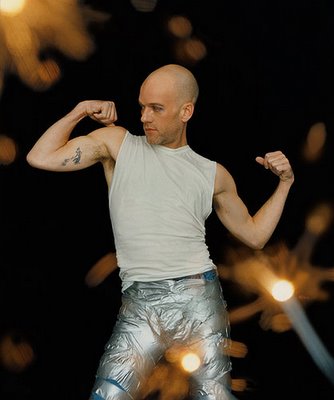 For me, in junior high and high school it was ALL about Michael Stipe. He was the lead singer and style icon of my favorite band. He was the sexually ambiguous celebrity that offered me enough fodder (posing pantsless in Details magazine, appearing on the cover of OUT magazine and calling himself a “queer artist”) for me to defend myself and my eccentricities to my small group of fairly-unforgiving friends. His politically liberal outspokenness and anti-label insistence has actually affected me more in adulthood than most other influences.
Fast forward to today and America is debating and legislating marriage equality, educating themselves about the transgender population, supporting out gay professional athletes, and consuming media that portrays a variety of non-conforming viewpoints. It would seem that the world is opening itself up and the need for labels and straight-forward identities would be lessening. But really I feel it is just the opposite. Behold two quick case studies from my week….
The first took place at work in my library. We are in the midst of a book fair, which provides students the opportunity to buy bright and shiny mass-market books at reasonable prices. Their selection seems vast but really it boils down to books for young boys (legos or sharks) vs. books for young girls (barbies or fairies) and books for older boys (sports and zombies) vs. books for older girls (dating or vampires). They also throw in “African – American interest” (Gabby Douglas or Beyonce bios) and “Spanish/bilingual”(mostly Dora the Explorer) editions. And almost invariably the students shop as the book fair thinks they should. Except for one 2nd grade boy I’ll call “J.”
J. desperately wanted to buy a magic fairy book. It is a new volume in a magic fairy series that I carry in the library and he always borrows every week. This book also came with a little necklace with a lipstick trinket. J. intuitively knows that wanting this book isn’t “okay,” and snuck around stealthily peeking at it whenever he thought no one was looking. I read these books with him and we discuss how special the fairies are, but my ally status can’t compete with his peers who laugh and his mother who doesn’t hide her shame. I watched him skittishly show his mother the $5 book and heard her immediate denial as she looked at the other little boys buying Pokemon and Minecraft books. She then went and got one of each of those and bought them for him despite his appeal to read the considerably cheaper magic fairy book.
Now I do not think his mother is a heartless monster, I think she generally supports and loves her son. (I have seen it in action.) But she also is trying to coax him toward things that the world tells her that little boys should like. She is trying to “protect” him. Interestingly, when I told this anecdote to my colleagues they all immediately blamed the mother for being bigoted and “homophobic.” I pointed out to them that J.’s interest in the book has nothing to do with his future sexuality but is more about his less rigid gender expression. But for them, and most people, boys who like “girl” things are just gay. And/or the opposite. I have fallen prey to this mentality myself. But I often remind myself that I am gay but I don’t like fairies. I love that J. does though! And this brings me to my 2nd case study.
The other night Thom and I hosted four other gay couples at our house to watch RuPaul’s Drag Race. This already is an unfortunately stereotypical event, but it became even more so when we got to the subject of Barbra Streisand. One of the boys, A., expressed an opinion about not liking Streisand, and then further it came out that he didn’t know her music or really anything about her. And all of the other boys ridiculed him. It was such a strange insistence that he, as a gay man, MUST not only respect this agreed-upon gay icon, but love her music and give a good old gay swoon when she was mentioned. Now some of this was sarcastic, but the actual truth still lived somewhere underneath. I definitely fit some gay stereotypes, and then there are others that make me feel like an alien other that could never measure up.
Assimilation is such an expected event in any circumstance that even when we think we are open-minded and loving in any way we still look for the rigid borders to color within. A boy must do this–unless he is gay–then he can do this–unless he is transgendered–then he must be a girl and do this–and so on and so on. And that is why I am so drawn to the idea of “queer.” By definition it simply means “differing” in some way, and in some circles it has become an open-ended term to welcome any type of expression. But because it still has an edge, it also appeals to my revolutionary sympathies. Queer is who I am. Queer is who I want to be.


 Me and Mr. Jones